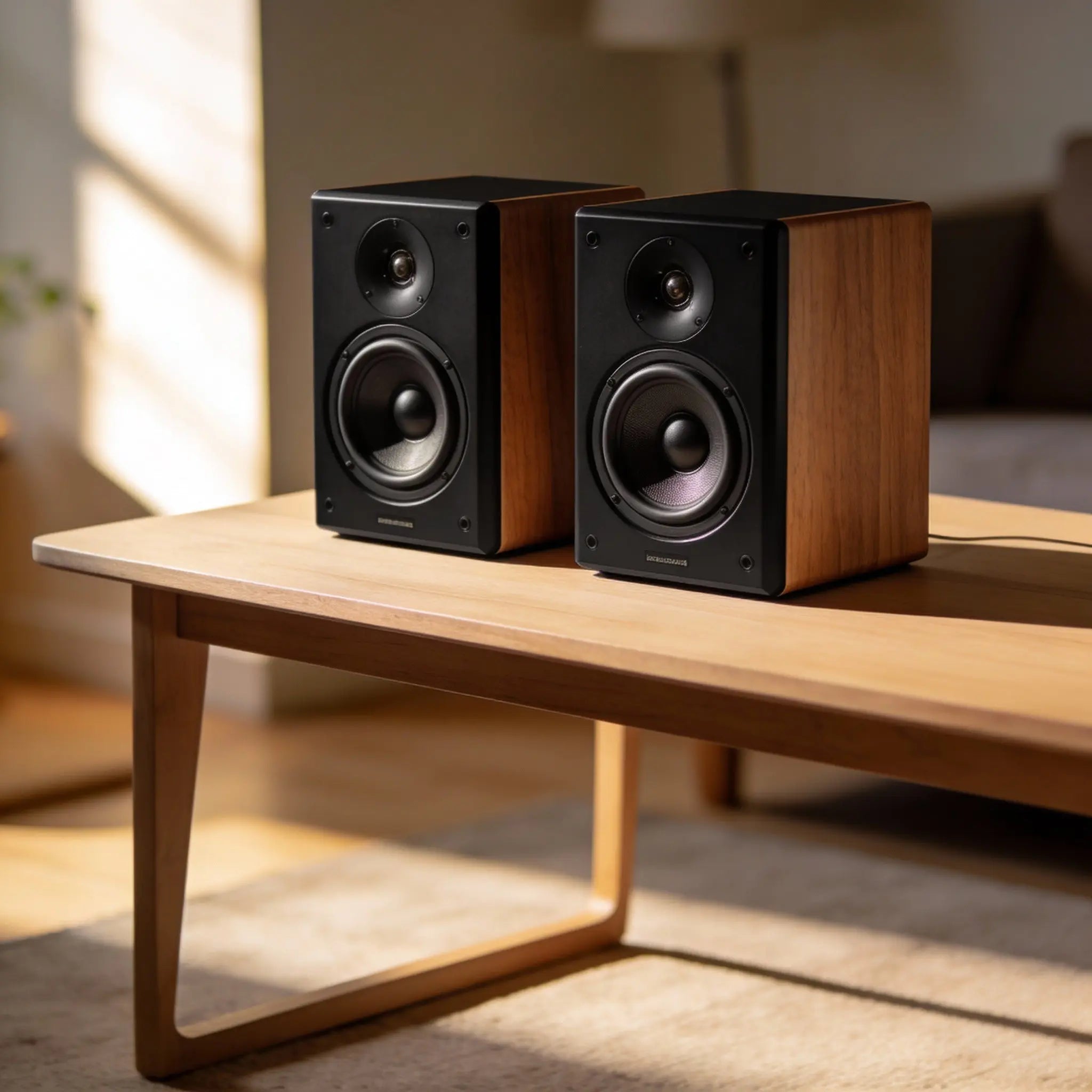
What is an active monitoring speaker?
Active speakers have built-in crossover and amplification circuitry, requiring only a power supply and music signal to produce sound, eliminating the need for an external power amplifier—truly "plug and play." Many studio monitor speakers, professional engineering speakers, and even general computer speakers and Bluetooth speakers are actually a type of active design.
The core advantages of active loudspeakers
For audiophiles starting from scratch, powered speakers can form a complete system with just a player and speakers. They are easy to install and space-saving, making them ideal for small apartments in Hong Kong. Monitor-grade powered speakers generally do not deliberately emphasize tonal coloration, resulting in a more natural and neutral sound. They can clearly present recording details and analytical capabilities, making them more enjoyable to listen to for extended periods.
Because the speakers and built-in amplifier circuitry are matched and tuned as a single unit by the manufacturer, the sound is more stable and less affected by cables or different amplifier pairings, providing a higher "guarantee" of sound quality for general users. It also saves space by eliminating the need for an amplifier, making it particularly suitable for desktop audio systems and CAS computer music playback systems.
Shortcomings that need to be noted
Some powered speakers require independent volume adjustment for the left and right channels, which can be a bit cumbersome for fine-tuning. Additionally, each speaker needs to be connected to a power cable and a signal cable; if the speakers are placed far apart, the wiring needs to be planned in advance.
Key Specifications for Purchase
-
Speaker unit size: The larger the mid-low/low frequency unit, the better the low-frequency extension and the stronger the dynamics, but the size will also increase. You should choose according to the actual space of your desktop, bedroom or living room.
-
Output power (RMS): Sound pressure level (sound volume) is related to power and sensitivity. Generally, the actual RMS output power (W) is used as a reference. If the space is large and you want to hear loud noise, you should choose a model with higher power.
-
Frequency response: This represents the frequency range that a speaker can reproduce. The wider the frequency response, the more high, mid, and low frequency details it can theoretically present. The common low frequency lower limit is about 50–100Hz, and the upper limit can reach 30–40kHz.
In terms of driver materials, silk dome tweeters deliver smooth and detailed high frequencies, making string instruments such as pianos and guitars more transparent. Kevlar woofers are less prone to deformation and distortion at high power, and have strong low-frequency extension, making them suitable for everyday entertainment and movie use.
Connection method and function selection
3.5mm and RCA are the most common analog inputs, allowing for easy connection to audio sources such as mobile phones, DAPs, DACs, CD players, and computers. Some models have a built-in USB DAC (USB Type-B), which can be directly connected to a computer via USB to easily create a high-quality desktop system.
Bluetooth functionality is ideal for everyday wireless music playback from your phone, offering ease of use. If aptX or aptX HD is supported, the sound quality can approach or even surpass that of CDs. If the speakers support HDMI ARC, they can be directly connected to the TV with a single cable, enabling bidirectional audio transmission without the need for additional optical or audio cables, catering to both home theater and everyday TV viewing needs.
Some mid-to-high-end active speakers also offer independent high/low frequency tuning and subwoofer pre-out, allowing for fine-tuning based on room acoustics and personal taste, while an external subwoofer can supplement deep low frequencies. These extra features are very useful for users who seek a cinematic experience and demand a powerful and immersive gaming experience.
Practical Buying Tips
-
Desktop/desktop: Optional 2.75–3 inch woofer, small active speaker with USB DAC or 3.5mm input, the key feature is its small size and non-obstructive handling.
-
For room entertainment: Choose a model with 3-4 inch drivers, medium power, and support for Bluetooth and RCA input to meet your needs for streaming, music, and gaming.
-
Living room home theater: We recommend a 4-7 inch woofer, higher RMS power, HDMI ARC, and subwoofer pre-out to create a simple yet cinematic two-channel system.