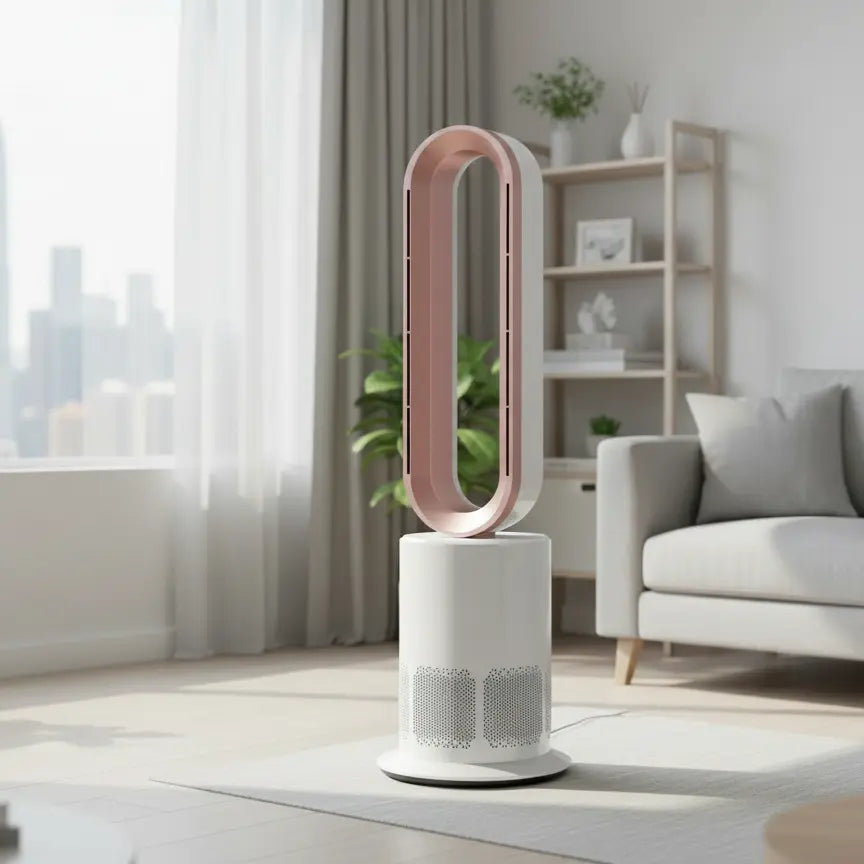
Hong Kong's weather is humid and hot, and there are many small apartments. When people want to buy a fan, they often ask: Are bladeless fans good? Are they worth buying? In fact, bladeless fans have become increasingly popular in households in recent years. This is not only because they look good, but also because they are safer, easier to clean, and provide a more comfortable breeze. Some models can even be used for both cooling and heating, and some even have added air purification functions, making them multi-functional.
From the perspective of Hong Kong families in 2025, the following is a summary of your most common questions and key points for choosing a bladeless fan, to help you pick the most suitable one for your home.
1. Are bladeless fans good? Are they worth buying?
The biggest advantages of bladeless fans are safety and comfort. Because there are no exposed blades, they are especially friendly to families with children, pets, or elderly people, reducing the risk of accidents such as pinched fingers or bumps.
While bladeless fans are generally more expensive than traditional fans, they are actually more cost-effective in the long run if you value quiet operation, a comfortable airflow, ease of maintenance, or want a single unit that can be used year-round (combining cooling and heating). Power Living bladeless fans are positioned as safe, durable, and multifunctional, making them suitable for Hong Kong families seeking comfort and peace of mind.
2. Bladeless fan vs. traditional fan: What's the difference?
Traditional fans rely on blades to directly cut the airflow, resulting in a more intermittent, harsher breeze that can dry out the eyes at close range. Bladeless fans, on the other hand, mostly use airflow multiplication to deliver air, resulting in a more even, gentler breeze with a more comprehensive coverage area.
Common differences include:
-
Bladeless fans offer a more refined airflow and less of a "direct, harsh" feeling.
-
With no exposed fan blades, the safety is significantly higher.
-
Cleaning is usually simpler (no need to disassemble the fan blades to sweep away dust).
-
Noise levels vary depending on the model, but higher-quality models are generally more stable.
3. Will bladeless fans be very noisy? Is it suitable for sleeping?
Many people worry that bladeless fans will make a "turbine noise". In fact, high-quality bladeless fans generally have good noise control. At low speeds, they are suitable for use in sleeping, baby rooms or studies. Even at high speeds, they are usually more stable than traditional fans, with less noise caused by blade vibration or looseness.
If you are mainly using it in the bedroom, it is recommended to pay attention to the following when purchasing: low fan noise level, whether it has a sleep mode, and timer shutdown function.
4. How does a bladeless fan work? What is its operating principle?
A bladeless fan doesn't mean "no wind"; rather, it means the fan blades and motor are concealed at the bottom of the unit. The general operating principle is: air is drawn in by a turbine → accelerated → ejected through a narrow air duct → creating a multiplied airflow, resulting in more concentrated and stable air delivery.
Simply put, it uses "airflow multiplication" instead of exposed fan blades, so both safety and wind feel are more ideal.
5. Are bladeless fans safe? Are they suitable for families with children or pets?
Because bladeless fans have no exposed blades, the risk of fingers getting caught is greatly reduced, and the danger of children reaching in to play is also reduced; for pet-owning families, it is also less likely that hair will get caught in the fan blades or be frightened by hitting the fan blades.
If you live in a family with children or pets, a leafless design is usually a safer choice.
6. Are bladeless fans any better? Key purchasing considerations for Hong Kong families in 2025.
To find a bladeless fan that's "right" for your home, don't just look at the appearance. It's recommended to choose one that matches your home's needs and functions. Pay attention to the following when purchasing:
-
Air supply distance and oscillation angle (even in small units, whole-house circulation must be considered).
-
Noise levels (especially important in bedrooms and studies)
-
Timer, sleep mode, remote/touch operation
-
Does it have both heating and cooling functions (which are useful in winter)?
-
Safety certification and protection features (especially for models with heating).
-
Additional features: HEPA air purification, plasma sterilization, etc. (depending on your home's air quality needs)
Some Power Living high-end bladeless fans include features such as HEPA air purification and plasma technology, making them suitable for families who value indoor air quality.
7. Is a bladeless fan that provides both cooling and heating worth buying? A single unit that can be used year-round is more practical.
Although winters in Hong Kong are short, the damp chill is quite noticeable. A bladeless fan that can provide both cooling and heating can deliver cool air in summer and warm air in winter, making it especially useful for small apartments: it saves space, and one unit can replace two (fan + heater).
In addition, 2-in-1 cooling and heating models are generally designed to be more airtight and easy to clean, making daily maintenance more convenient. If your home has limited space, or you don't want to buy too many appliances, a bladeless fan that combines cooling and heating is usually a better choice.
8. Are bladeless fans suitable for use in bedrooms?
Suitable for those who dislike direct airflow or prefer a gentle breeze. The bladeless fan provides a more even airflow, and with its timer and low-noise setting, it's especially suitable for bedrooms, baby rooms, or homes where it's used for extended periods at night.
We recommend selecting items with features such as: sleep mode, low-light display, and timer function to enhance the nighttime user experience.
9. How much do bladeless fans typically cost? (Hong Kong market price, 2025 reference)
The price of bladeless fans in Hong Kong is usually around to The amounts vary depending on the Hong Kong dollar, mainly depending on:
-
Brand Positioning
-
Air volume and silent technology
-
Does it have heating and cooling functions?
-
Does it have additional functions such as HEPA purification/sterilization?
-
Local maintenance and after-sales support
If you only use it occasionally in the summer, the entry-level model is sufficient; but if you are looking for year-round use, a quiet bedroom, and air quality management, the mid-to-high-end models will better meet your needs.
10. Which side is better to buy for a bladeless fan? Local maintenance is also important.
It is recommended to prioritize brands that offer local maintenance services in Hong Kong, physical stores, or comprehensive customer support, as problems are easier to handle and you can use them with greater peace of mind.
Additionally, if you plan to buy a "Taobao/parallel import" product and then replace the plug with a British standard one yourself, be aware that it may not fully comply with the relevant safety specifications of the Hong Kong Electrical and Mechanical Services Department (EMSD), especially for heated products. Poor contact or overloading could increase the risk of overheating or even fire. For safety reasons, it is safer to purchase products with compliant designs and local after-sales service.
11. How to properly move a bladeless fan? Avoid loosening the wiring.
When moving a bladeless fan, it is recommended to lift the entire unit before moving it to another location, rather than lifting it by the top or the air outlet. This is because some designs have internal wiring, and repeatedly "dragging by the top" may loosen the connections, affecting the stability and safety of use.
12. What safety specifications should I be aware of for bladeless heater fans?
If you are buying a bladeless fan (heating and cooling unit), it is recommended to pay close attention to the following safety features when purchasing:
-
Overheat protection: Automatically stops heating when the temperature is too high.
-
Tilting Power Off: The machine will automatically cut off power if it falls over.
-
Overcurrent/Overload Protection: Automatic protection against abnormal current.
-
Compliant plugs and certifications: better suited to Hong Kong's electricity environment
Taking the Power Living bladeless fan as an example, it features built-in overheat protection, tip-over power-off protection, and abnormal current protection, providing greater protection for long-term home use.
Frequently Asked Questions (FAQ)
Are bladeless fans always cooler than traditional fans?
Not necessarily, but bladeless fans generally have a more even airflow, making you feel more comfortable. If you need stronger cooling, you can also use them in conjunction with an air conditioner or dehumidifier to enhance the effect.
Do bladeless fans need to be cleaned regularly?
Yes. It is recommended to wipe the outer casing and air inlet area regularly to prevent dust accumulation from affecting airflow and odor; for models with purification functions, the filter should also be replaced according to the instructions.
For smaller units, is it better to buy a tower-type or ground-mounted type?
In Hong Kong, tower-style units are generally more space-efficient for smaller apartments; if you want a higher air supply position or a wider airflow range, you'll need to consider the room layout and bed height.